
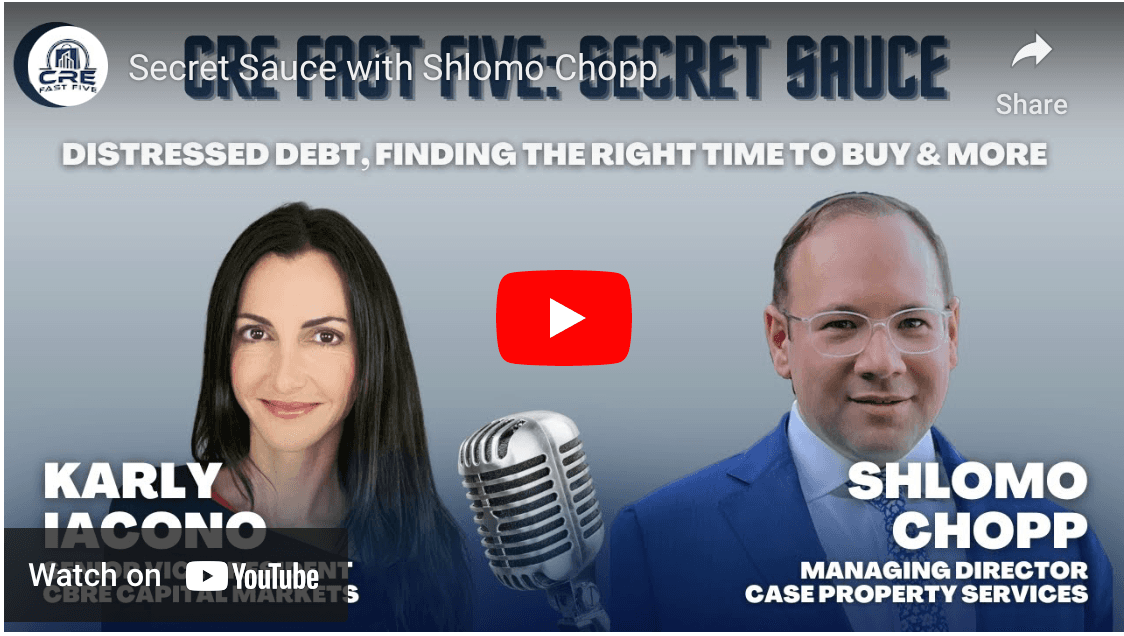
Secret Sauce With Shlomo Chopp
CRE Fast Five with Karly Iacono
In this September 2022 episode of Secret Sauce, the rapid-format interview series hosted by Karly Iacono, Senior Vice President at CBRE Capital Markets, Shlomo Chopp compresses a career's worth of distressed-debt thinking into eleven minutes. Shlomo is Managing Partner of Case; at the time of this recording the firm's workout advisory operated as Case Property Services. The full video is above, and the highlights follow.
The Octopus Beneath the Surface
Karly opens by asking what the firm actually does, and Shlomo's answer starts with a picture of how commercial real estate really works. When everything goes well, ownership looks simple. Beneath the surface it is an octopus with many tentacles: lender, buyer, seller, property management, tenants, legal. As long as the system runs like clockwork, decisions are routine. When something breaks, owners discover that these are deeply complex structures, and most owners, operators, and even seasoned professionals are not experts in what sits underneath. His role, built over the decade since the last downturn, is digging into the mechanisms behind the loan documents so that when an issue appears on the horizon, the response is designed for the problem after this one, not just the problem in front of you. If the steering wheel fails, you find the hand crank. If the crank fails, you had better already know what comes next. Karly's summary, "Shlomo the fixer," is shorter.
Problems Start When You Try to Solve Problems
Asked how owners end up in distress in the first place, Shlomo points to the moment most borrowers treat as a formality: the term sheet. When you negotiate a term sheet you are negotiating with a salesman. The second you sign it, you are dealing with someone whose job is to execute it, who does not care whether your deal lives or dies. The leverage you will wish you had in year five is won or lost in that phase, so the discipline is to negotiate as many points as possible before signing. Structured finance itself, he notes, grew out of the savings and loan crisis; complexity was the solution to the last problem, which is precisely why it becomes the source of the next one.
For owners past that point, his advice is blunt. When you see a problem coming down the pike, do not assume it resolves itself satisfactorily. Assume there may be an issue and understand your alternatives before you need them. It is a game like chess: the loan documents gave away most of your leverage, and the question is what you can do today to create more without backfiring and triggering recourse guarantees. That early, structured look at a developing problem is exactly what our advisory practice is built for, and the earlier the call, the more moves remain on the board.
Reversion to the Mean, Not Obituaries
On the market, Shlomo is a believer in things reverting to the mean. Office was already being declared dead in 2022; his view is more precise. Tenants will ultimately have to lease space, and at rates that make sense, which means the market clears not just on an owner's basis but on the tenant improvements a tenant needs the owner to fund. Some office products and office types get weeded out. Declaring the whole category finished does not make sense. Keep your eye on the ball, do not act too quickly, and let your ultimate customer, the tenant, figure out what they want before you make ten-year decisions around them.
"Today is the Best Day to Buy" is a Myth
Asked for one belief that contradicts what the market says every day, Shlomo does not hesitate. The claim that today is the best day to buy is, in his words, a moronic comment, because it is indistinguishable from saying you will buy at any price. A commercial real estate investment is a three-to-ten-year commitment, and the retailers who stocked inventory on COVID-era assumptions, or the warehouse demand that evaporated once e-commerce normalized, show what happens when a moment gets mistaken for a trend. His test is introspective: will you be happy in ten years that you bought today? For private investors especially, the priority is not chasing return but protecting principal. And the flip side, he adds, is just as important: when the right deal hits you in the face, act.
The episode closes with the actual secret sauce. Shlomo describes himself as always hungry, literally and figuratively; a career built without inherited money, by outworking the next guy, thinking long-term, and, as he has gotten older, taking care of himself so the pace is sustainable. Watch the full conversation above for the unabridged version.