
Business Models Now Change Faster Than Leases and Debt
Shlomo Chopp on The Zelnik Exchange: why real estate distress is structural, how one word turns a non-recourse loan recourse, and what landlords still refuse to fund.
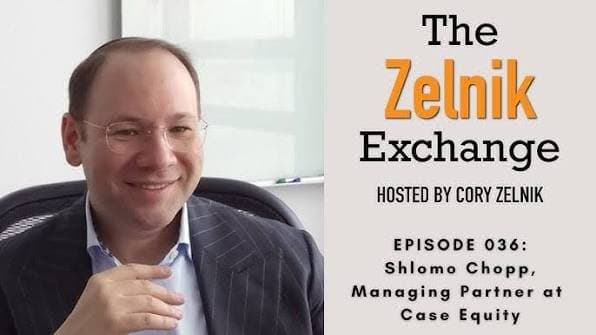
Shlomo Chopp, Managing Partner of Case, joined host Cory Zelnik on The Zelnik Exchange for episode 036, a forty minute conversation published July 9, 2026. Zelnik is a veteran retail real estate broker and founder of Zelnik & Company. The discussion moved from Chopp's start in proptech in 2003, a business he entered because "some guys are born with a lot of connections, some guys are born with a lot of money, I was one with neither," through the 2008 crisis and into the part that matters most for owners today: the assumptions underneath long dated real estate debt no longer hold. What follows draws on that episode, which you can hear in full on Apple Podcasts or watch on YouTube.
Why Is Commercial Real Estate Distress Structural and Not Just Cyclical?
Distress today is structural because the businesses that occupy space change faster than the leases and loans written against them. A lease runs ten years and a loan amortizes over decades, while a tenant's operating model can be rebuilt in eighteen months. When the occupancy assumption breaks, the debt does not adjust with it.
That is the argument behind Chopp's article "New Graves to Dance On," which Zelnik quoted back to him on air. Real estate has always sold itself as a durable hard asset. The durability was never in the concrete. It was in the predictability of the business inside it.
One Word Can Turn a Non-Recourse Loan Into Recourse
The most immediate risk most borrowers carry is in documents they already signed. Chopp described origination as a fast talking process in which a borrower and even the borrower's counsel sign off on language whose operational consequences nobody has mapped.
"You have no clue that the practices that the bookkeeper is doing in the office right now literally makes this non-recourse loan a fully recourse personally guaranteed loan," he said. Lenders will offer extra proceeds or a few basis points in exchange for changing a single conjunction. His view of that trade is blunt: "You just sold your property for 100 grand because you're going to lose it based on that 'or' change to an 'and.'"
Two practical consequences follow. First, recourse exposure is usually created by ordinary back office behavior, not by a dramatic event. Second, the borrower who reads the documents before a default has options that the borrower who reads them afterward does not. That sequencing is the whole basis of our [borrower's guide to CMBS workouts.
What Sam Zell's Gravedancer Thesis Still Gets Right
Zelnik raised Sam Zell, whom he called one of the top five legends of the industry. Chopp, who cold emailed Zell and got a meeting he still calls one of the thrills of his life, restated the gravedancer logic in mechanical terms.
"You could dance on someone else's grave if you understand that when lots of money comes into the market and the wrong people have it, they make bad investments," Chopp said, "which brings those assets back to market." The second half is the part owners forget. "Because banks are not equipped to be able to handle the turnaround, it puts you, the expert operator, to be able to go and turn it around and make it profitable."
Chopp and Zell did not agree on everything. Zell expected office to recover and, in Chopp's account, "told me personally he was not a believer in retail at all. I had a big argument with him." Chopp's own position sits between the two poles. Space is not obsolete, but usage is bifurcating, and the gap between winning and losing assets widens from there.
Retail Filled Its Vacancy With Food, and That Carries Risk
E-commerce did not win on economics. "E-commerce is not a profitable business at all, but it feeds other businesses," Chopp said. It survived on cheap capital and rising demand, and along the way it cleared out thin margin retailers. Landlords backfilled that vacancy with experience, and experience mostly meant food and beverage.
That is where Chopp sees an unhedged bet. "What's really unnerving to me is the tried and true fact that in a downturn, the first thing that goes is discretionary spending, including eating out." Even inexpensive fast food costs more than cooking at home. Zelnik pushed back that food and beverage will not disappear, and framed it as survival of the fittest.
Curation Beats Volume
Chopp agreed on the direction while faulting the execution. Many centers filled space with weak operators. He pointed to Tanger, which dropped "Outlets" from its name as it began buying non-outlet centers, and to chief executive Stephen Yalof, as an example of curated and lighter touch experiential leasing. Luxury is running the same play from the other end, with a café inside Hermès' new Madison Avenue flagship and a redesigned café at Tiffany.
The caution is that no single idea stays fresh. Properties that stop innovating meet the oldest fate in retail real estate, which is that the main drag moved.
AI and Data Centers Test the Limits of the Long Lease
Chopp's sharpest example of self inflicted obsolescence was not retail. It was artificial intelligence infrastructure. Chip capability is advancing fast enough that a data center delivered six months ago is already behind, and "you can't change data centers every six months like you change a website."
So he asked the question the industry has avoided: "Are traditional leases the right way to go?" He does not pretend to have the answer. "I don't have a better solution," he said, while warning that walking away from long duration real estate would leave pension capital without an obviously safer place to go. The useful takeaway is narrower and still actionable. Duration risk now sits on the tenant's business model, and that belongs in underwriting rather than in a footnote.
Landlords Cannot Outsource Tenant Success
Every lease is written for the what if scenario, and a perfect lease is one nobody ever needs to reread. Chopp cited Prologis as a REIT that keeps an active relationship with a tenant from signing through renewal instead of signing and forgetting.
He contrasted that with a retail conference panel that paired the chief executive of Authentic Brands Group with the late David Simon of Simon Property Group. Each said driving foot traffic was the other side's job. "Both of them were wrong," Chopp said.
His prescription is operational rather than philosophical. "Landlords need to stop thinking that all they need to provide is four walls." Staffing a genuine tenant and customer success function costs money, and he does not think the money is the obstacle: "You check out most landlords and their margins are really healthy. It's not a real problem." The filter is will, not capacity. "The people that get out ahead of it and have the dollars to do it, the guts to do it, and the support of the boards are the people that are going to survive moving forward."
Where the Losses Land
Chopp does not spare the borrowers who create their own distress. Some "cash the heck out of a building," then arrive at the lender claiming they cannot refinance. But he assigns the other half of the blame upstream. "It's not just their fault. It's the lenders enabling it," he said, describing origination that leans on a superficial property condition assessment prepared by an inspector with no real authority. Everyone in the chain is paid to get the loan out the door.
The bill arrives somewhere else. "You know who gets screwed at the end of the day? It's the small LP investors," Chopp said, meaning the pensioners whose capital sits inside the pension funds, private debt funds, CMBS trusts, and banks that funded the loan. "No one understands the problem that happened at the time the loan was made, sold, taken."
His underwriting comparison is the cleanest summary of the gap. Lending to a listed company typically demands roughly two times cash flow coverage. Real estate lending is often written to about 1.15 times, with a slice of proceeds held back as sponsor incentive. That structure only works if the sponsor hits the plan. Chopp is not optimistic about voluntary reform: "No one cares until institutions fail again."
What This Means for Borrowers Now
Chopp describes himself as being on the dark side from a lender's perspective, since he represents borrowers. He frames the work differently. "I'm not trying to find a way to screw the lender. I'm trying to find a way to have the lender comprehend and understand the true issue at hand," he said, and to accept a resolution better than the alternative available in the open market.
That is the practical order of operations. Read the loan documents before the default, not after. Understand which behaviors in your own office change your liability. Learn who on the lender's side actually holds the authority to approve what you intend to propose. Cash management mechanics matter here too.
Facing a maturing or distressed commercial real estate loan? [Request a consultation](/advisory) with Case's senior restructuring team in New York.
Frequently Asked Questions
How can a non-recourse commercial loan become recourse?
Non-recourse carve outs convert a loan to recourse when specific borrower conduct occurs, and much of that conduct is routine bookkeeping and cash handling rather than a dramatic breach. Small drafting changes, including a swap between "or" and "and," can widen those triggers considerably.
Why is commercial real estate distress considered structural today?
Because tenant business models now change faster than the leases and loans underwritten against them. A ten year lease and a decades long amortization schedule assume stable occupancy demand, and that assumption no longer holds across office, retail, and newer asset classes.
Why is food and beverage leasing a risk for retail centers?
Discretionary spending, including eating out, is the first category consumers cut in a downturn. Centers that replaced failed retailers with a high concentration of thin margin food operators have concentrated their exposure to that spending rather than diversified it.
Who bears the loss when a commercial real estate loan defaults?
The loss typically travels down to small limited partners and, ultimately, to pension beneficiaries whose capital funded the pension funds, private debt funds, CMBS trusts, and banks that made or bought the loan.
Listen to the Episode
Episode 036 of The Zelnik Exchange hosted by Cory Zelnik of [Zelnik & Company, was published July 9, 2026 and runs 40:08. Full credit to Cory Zelnik and the Zelnik Exchange team for the conversation. Listen on Apple Podcasts or watch on YouTube.