
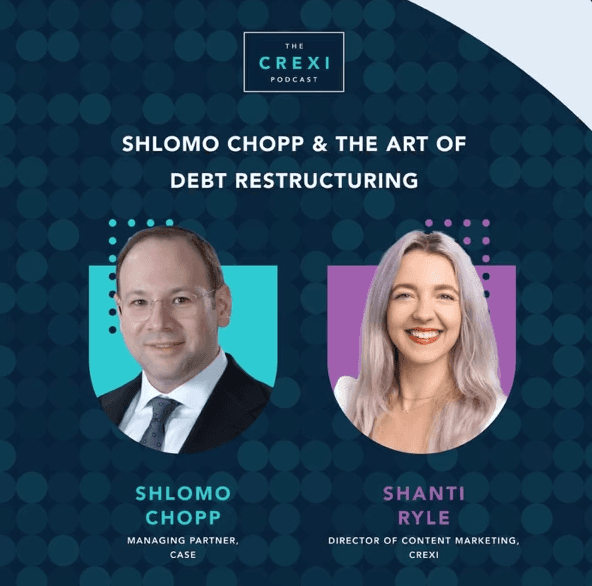
Shlomo Chopp & the Art of Debt Restructuring
The Crexi Commercial Real Estate Podcast: Conversations in All Things CRE
Shlomo Chopp, Managing Partner of Case, joined The Crexi Podcast in April 2025 for a wide-ranging conversation on the craft of commercial real estate debt restructuring. Over roughly seventy-five minutes, he traces his path from selling PropTech software to real estate finance brokerages in 2003 to advising on nearly $5 billion in distressed property and debt situations, and he explains, in unusual detail, how workouts actually get done. The full episode is above; what follows is a summary of the main arguments.
The Mousetrap Inside the Loan Documents
Shlomo's entry into CMBS workouts came out of necessity. In 2010, with few deals happening anywhere, his attorney pointed him toward CMBS, on the theory that bondholders would not unwind the way banks did in the savings and loan crisis. His response was to do what most people would not: open the pooling and servicing agreement, a document that can run past a thousand pages, and find the parts that mattered.
The process the servicer is contractually required to follow, he realized, is itself the roadmap. They need an appraisal, so the question becomes how to get the right number in front of them rather than an inflated one. They need to justify a restructure, so the question becomes how to put a proposal on the table that fits the lender's incentive set even though the lender is taking a loss. He still uses parts of that framework today.
Preparation is the Entire Negotiation
The central theme of the episode is that a borrower entering a workout typically has zero inherent leverage. The law is straightforward: if you borrow money, you owe it back, and the lender holds a contract it is entitled to enforce. What remains is preparation. Shlomo describes the compelling case as three arguments made together: why the lender is better off doing this deal, why it is worse off not doing it, and why this borrower is the right counterparty to execute going forward. Assembling that case means finding every pressure point across the legal, property, market, and loan-enforcement dimensions, then translating it into a coherent business plan and proposal.
He also puts a number on it: he wants sixty days before the lender ever hears there is a problem. The day the lender learns of trouble, its own diligence begins, and an advisor who shows up later is arguing against conclusions already formed. Arrive first with a complete picture of the asset and you become the baseline the lender works from.
The most common mistake he sees, in his words, is lack of preparation, including from some of the largest owners in the market. Loan documents have become complicated enough that a property has to be operated within their confines, not just within good market practice. Most owners are good operators, not loan document experts, and that gap is where problems compound. This is the same discipline covered in our borrower's guide to CMBS workouts.
Creating Leverage Where None Exists
The episode's centerpiece is a restructuring story told start to finish. A loan of roughly $20 million sat against a mixed-use property with a retail component that never hit pro forma, a master-leased residential component about to go vacant, and a personal guarantee with several million dollars of exposure.
CASE converted the loan to interest-only on day one, then ran an open auction process with the lender's credit committee watching, which established what the property was actually worth against an appraisal that kept insisting value was fine.
When the master tenant vacated, the proposal to the lender was two doors: door one, the borrower re-tenants the property, funds the work, and keeps making payments for twelve months; door two, come get me. The lender chose door one. A buyer surfaced near the debt amount, the deal closed, and the guarantor walked away with a release of a guarantee that carried four to five million dollars of exposure.
No cloak and dagger, as Shlomo puts it: the lender was inside the process the whole way, and the leverage was created by what was brought to the table, not found in the documents.
This Cycle is Not the GFC
On the market, Shlomo draws a sharp contrast between this cycle and the great financial crisis. Then, the mood was despair and banks were failing; now, the defining feature is hope, a lingering assumption that rates will fall or the government will not let things break. He is skeptical. The rate move was a valuation event, and real estate does not reprice the way bonds and stocks do, so owners are living inside ten-year decisions made under yesterday's assumptions. What he sees now is capitulation: owners increasingly willing to accept where values are and transact rather than keep funding hope, and lender-directed short sales doing the work of price discovery. He also dismantles the idea of passive income, pointing to net-lease owners who stopped monitoring tenant credit and found their distributions swept into lender-controlled accounts after a downgrade, the cash management mechanics we explain in our piece on cash traps and lockboxes.
Asked where he would put $50 million immediately, his answer is characteristically specific: high-quality single-asset single-borrower CMBS bonds on office, bought at a discount, at whatever attachment point in the capital stack matches your risk appetite.
The conversation closes on the misconception he most wants corrected: that this business runs on connections. Relationships open doors, but no lender takes a loss as a favor. What gets deals done is preparation, a credible sales pitch, and understanding what the other side needs. That is the approach behind our advisory practice.