
Why Distressed Commercial Real Estate Deals Die at the Table
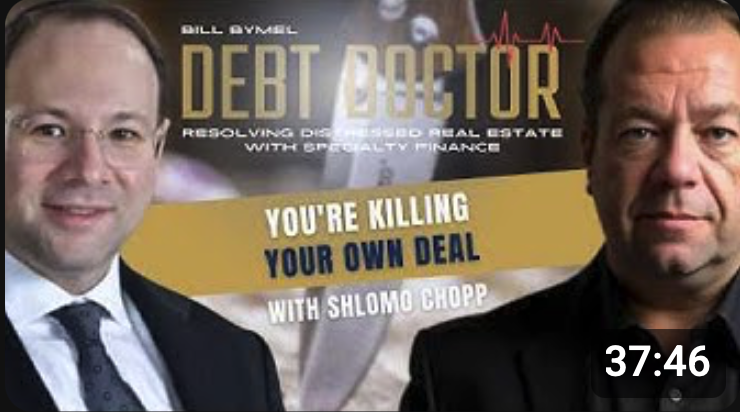
The deals collapsing in today's commercial real estate market aren't failing because of bad assets. They're failing at the negotiating table and usually because of moves the borrower didn't know were fatal.
Shlomo Chopp has restructured some of the most complex distressed commercial real estate workouts in the country. He joins Bill to talk about what actually saves a deal when a loan goes sideways and why the instinct to draw hard lines with your lender is often the move that ends everything.
What separates a workout from a wipeout isn't the asset. It's whether you understand who's sitting across the table — their incentives, their constraints, their pressure points — and whether you can communicate in a way that opens doors instead of slamming them.
Banks aren't trying to foreclose. They're trying to recover maximum proceeds. Walk in knowing that, and the whole conversation changes. Shlomo walks through what that looks like at every level — banks, private lenders, CMBS bond managers — the motivations differ, and so does the playbook.
Having the right team on your side of the table determines whether you walk out with a deal or a default. He also makes the case that your toughest workout might be the best off-market deal hiding in your portfolio right now.
TRANSCRIPT:
Shlomo Chopp: Wow. Wow, wow, wow, wow, wow.
Bill Bymel: [laughs]
Shlomo Chopp: Well, the premise of that entire question is-
Bill Bymel: [laughs]
Shlomo Chopp: ... needs to be really questioned.
Bill Bymel: Little loaded.
Shlomo Chopp: You know, we have, we have a great team and we know what we're doing. We have it down to a science. And obviously every negotiation is its own, is its own negotiation. It's not a, it's not a, uh, rinse and repeat type situation. Every property is unique. The truth is everyone's really concerned about their existing assets, and I get it. You know, sometimes you gotta trade out of a stock to trade into another stock. Your time is energy. You know, so sometimes just walk from a deal that doesn't make sense. But other times recognize that your off market deal is your workout.
Bill Bymel: I speak a lot of, in the last few years, about fallacies. I feel like we... There's cons- There's just, in every industry, especially in ours, there's this thinking that kind of becomes the norm of how to deal with things, and it's just so off, off from, from what really works.
Shlomo Chopp: The lender doesn't want your property. So it almost sounds like you could actually not be a total insert it and bleep it out.
Bill Bymel: Yeah. [laughs]
Shlomo Chopp: And let's, let's go about this differently.
Bill Bymel: The bank would rather sell it for even less to a third party just to save face, I think, right?
Shlomo Chopp: Exactly. [upbeat music]
Bill Bymel: Welcome to The Debt Doctor podcast, where we deliver the definitive prescription for navigating distressed real estate debt. I'm your host and America's most qualified debt doctor, Bill Bymel. I've spent my career investing in, diagnosing, and reviving thousands of distressed real estate situations. The Debt Doctor prescribes proprietary remedies to help you identify, acquire, and monetize undervalued real estate assets. Each episode gives you insider access to the strategies top cohorts use to transform market volatility into double-digit returns. If you enjoy what you hear today, hit the follow button, subscribe so you don't miss an episode, and please share your support with a quick review. You can find me on the web at billbymel.com. Thanks for joining this episode of The Debt Doctor. [upbeat music] Shlomo Chopp, welcome to The Debt Doctor.
Shlomo Chopp: Hey, Bill. Thanks for having me.
Bill Bymel: You know, this is a take two, I have to admit to the audience, because, um, somewhere lost in the annals of YouTube recording history is a really bad audio of our first conversation a few months ago. I've been so excited to share what we were talking about with the world, so we're gonna have to recreate it. But actually, there's a whole new conversation to be had, um, around the world of debt. And it seems like every c- every couple weeks there's, there's new, new stories and, and whatnot. Uh, thank you for taking the time out of your busy schedule, uh, to spend a few minutes with my audience and me today.
Shlomo Chopp: It's my pleasure. I appreciate you having me.
Bill Bymel: Um, give the wor- Y- you have become a little bit of a legend, uh, I must say, in the world-
Shlomo Chopp: Yeah
Bill Bymel: ... [laughs] of CMBS restructuring advisory, um, commercial mort- mostly commercial m- mortgage-backed securities, larger properties. Um, I remember from our, all of our conversations, you, you, you're at, you're fortunate to be at a place where you turn deals down, that people are coming to you more often than you can really take on the capacity. Give a little bit of a sense to the world, to our audience, who you are, what it is that you do, and what makes you so great. [laughs]
Shlomo Chopp: Wow. Wow, wow, wow, wow, wow. Well, the premise of that entire question is-
Bill Bymel: [laughs]
Shlomo Chopp: ... needs to be really questioned.
Bill Bymel: Little loaded. [laughs]
Shlomo Chopp: Yes, a little loaded. Turning people away, it's not something I do out of fun.
Bill Bymel: Mm-hmm.
Shlomo Chopp: And it's not something I do because I don't have the capacity. You know, we have, we have a great team, and we know what we're doing. We have it down to a science. And obviously every negotiation is its own, is its own negotiation. It's not a, it's not a, uh, rinse and repeat type situation. Every property is unique. As much as, you know, we recently put in a, uh, uh, our write-ups, which, uh, could be 40 pages long, like dense Word document. That's before the Excel. Um-
Bill Bymel: I know, I had to have ChatGPT reinterpret the whitepaper.
Shlomo Chopp: No, no, no, no, no. ChatGT- ChatGPT misses the point, right?
Bill Bymel: Nuance. It totally misses the nuance.
Shlomo Chopp: It misses the nuance. But that's the thing, and that's what I'm gonna get to, right? This is a, a tertiary market office building that, you know, is still having COVID effects, and the reason it ha- it's having COVID effects is because in a tertiary market you're not having tenants come in as much, right?
Bill Bymel: Mm-hmm.
Shlomo Chopp: So in a typ- typically, typically in a tertiary market, you have demand that fills an office building, and then tenants do leave, but not that many tenants co- and not that many tenants come in. But even if a tenant leaves, with time you have a tenant to backfill the space. The problem is right now the bottom of that cup is letting more water out than is coming into, into the pro- into the cup, right?
Bill Bymel: Mm-hmm.
Shlomo Chopp: And, and that's a challenge. You really have to... You can't just say, "Well, here we go. That's the problem. Have a good day." It's really like, okay, but why is it, for example, that the market's, um, 90% occupied and you're at 60? Well, the reason is because everyone else in the market has 10,000 square foot floor plates and a core, and, you know, I have-You know, 50, 60, 70, 80,000 square foot floor plates. So you gotta explain the story, you gotta explain the nuance, you gotta take things into account. So yeah, I could do it through ChatGPT if I guided it for 17 hours to get what it, what it needed to do. Really, really, you know, we do use artificial intelligence to help us draft.
Bill Bymel: Mm-hmm.
Shlomo Chopp: But to be the editor that we then go and clean up where it misses the point, so to speak, right? But the narrative is we visit the asset and everything. So the point I'm making is that we turn away people that don't fit how we want to present ourselves to our le- to our lenders, right? I don't wanna represent the slumlord. Because you go to your lender and you say, "Hi. I ran the property into the ground. The property's worth crap now, but it's because of the market. Give me a deal."
Bill Bymel: Right. And I over-leveraged it-
Shlomo Chopp: I'm not gonna win
Bill Bymel: ... when the rates were low and I could take advantage of you.
Shlomo Chopp: Yeah. I mean, get a public defender for that one.
Bill Bymel: Right. [laughs] Exactly.
Shlomo Chopp: So, so the point, the point I'm saying is that like, yes, we do turn away, but that's only be- only if we believe that the client doesn't represent the ideals that we're trying to embody, if you will.
Bill Bymel: Right.
Shlomo Chopp: Right?
Bill Bymel: Yeah. No, that makes a lot of sense, and that has a lot of integrity to it as well. Do you ac- are you finding yourself looking at certain lenders that, you know, if a client comes to you with a loan from XYZ Bank or such and such, uh, bond managers or, you know, it's at a certain servicer per se, do you actually make that as a calculation on whether or not you think you can add value to a transaction, uh, that's in distress?
Shlomo Chopp: So the a- the answer is yes and no. So yes in that we are aware that this lender is gonna be more difficult, and yes we actually advise the client about the challenges involved.
Bill Bymel: Mm-hmm.
Shlomo Chopp: But no, we don't say, "Oh, we can't deal with it." Like, because e- even if we can't ach- we don't believe that it'll be as, as easy to achieve the success as it would be with another lender, um, it doesn't matter. We are going to do a better job than the borrower could do on their own.
Bill Bymel: Take a, us through-
Shlomo Chopp: So it's about full disclosure, really
Bill Bymel: Yeah, of course. I mean, that's right. Fiduciary, you have a real good sense of fiduciary responsibility and, you know, where you sit inside of a deal, you know, in terms of, you know, what you can and can't do. And that's by, by, that's what makes a great advisor is whether it's in real estate or loan restructuring or in law, you know, is, is that perspective. Um, give, to take a step back, because, you know, some of the folks that listen may just be everyday folks. They may be realtors that deal with residential properties. A lot of the, a lot of people in the residential real estate world. Take a step back and explain what a typical deal looks like, what, you know, uh, give an example of, you know, without naming names, of, of a recent transaction that you, that c- came to you, what the situation was, how you, how you and your company, um, services that situation and adds value.
Shlomo Chopp: Let me talk about a scenario where there was a smaller borrower that came to us and in this situation we were adding value in that we weren't doing a full-blown workout, but rather assisting them almost as a back office and with strategy questions. So let me explain what I mean by that. Our core service, we typically work on, uh, we typically work on loans that are gonna be $30 million up. So right now we have over 20 loans, and with a total balance in the billions, right? So-
Bill Bymel: Mm-hmm
Shlomo Chopp: ... that we're working out. And if someone comes to you with a $3 million loan, the barrier to entry for them is that I take a significant fee for that, and it's just, it's too taxing. They don't have the money for it, it's difficult, et cetera. For a while, I would regrettably say, "I'm sorry, I just can't service you." But then we decided that, I decided I was doing, you know, out of guilt to a certain extent, um, I was giving away a lot of my time giving free advice.
Bill Bymel: Mm-hmm.
Shlomo Chopp: And it just was taxing. Like, I would get WhatsApp messages with loan agreements, "Highkey, please call me." I don't know who you are. I literally would get like, "Highkey, please call me," or... And it's, like other people, like they make me sign an NDA before they send me the stuff-
Bill Bymel: Right
Shlomo Chopp: ... and so like, okay, right? And we decided that what we're going to do is instead of s- the s- where we typically go in and try to articulate to the lender the distress of the asset, stay out ahead of the situation, asset manage the process, set up the negotiation, go through the process, and negotiate a deal.
Bill Bymel: Mm-hmm.
Shlomo Chopp: For these smaller borrowers, we're gonna try to provide a service that's cost-effective for them, but compensates us for our work.
Bill Bymel: Mm-hmm.
Shlomo Chopp: So instead of being out front, we're there in a support role. So our, our team does the back office work. We look at what happened, what is, what needs to happen, right? We'll underwrite the deal, and we bill out very well on an hourly basis for that, and we make, we make nice money on that, right? But I don't have to worry about the trajectory of the deal. I finish the underwriting. I then come to them and say, "Hey, guys, here's the problem you have. Here's the potential solution you should, you should pursue."And tell me about your conversation. Let's set up an hour call. And I, I advise them on what to do. But when I hang up the phone, unless they call me back, I don't have to worry about this.
Bill Bymel: Right.
Shlomo Chopp: It's not something that's on my head, right? So we call that the pre-workout, if you will. Okay? So a classic example, um, that we had recently, um, this was various people, and I could go into detail. Guy comes to us, he has a loan with a bank, a multifamily deal in New York City, got the rent stabilized issue involved here. It's all these problems, right? And we underwrite it and we identify where they potentially have exposure. We identify, um, the valuation. We help them get broker opinions of value, and then we guide them w- to how to work with the lender. So here is a spin on something that's so obvious that gets a deal done.
Bill Bymel: Yeah.
Shlomo Chopp: And this is, I think, good for anyone who has a loan-
Bill Bymel: Right, like
Shlomo Chopp: ... and trying to figure it out.
Bill Bymel: Some, some client paid thousands of dollars for this advice, folks. [laughs]
Shlomo Chopp: Now listen, listen. But every... Listen, it's not rinse and repeat. Everything is, you know-
Bill Bymel: That's right
Shlomo Chopp: ... right? Some people-
Bill Bymel: It's unique to this situation, but it shows that, you know, how you can spot the defects and, and advise from afar.
Shlomo Chopp: Yes. So what ha- what happened is, what happens is, is that everyone says the lender doesn't want the property, right? So in a deal maker's mind, which borrowers are deal makers, they say, "Lender doesn't want the property, so we're gonna play hardball. We'll offer 30 cents on the dollar because they gotta take my deal." And that doesn't work. It doesn't work because it's almost as if you have someone that's stuck and you say, "I'm gonna shove it down your throat." It's just like it do- it doesn't work, right?
Bill Bymel: Yeah. I agree. I see this all the time with sponsors, especially in the New York area where [laughs] where they get under trouble. They figure, "Oh, no," you know. Th- th- you know, they think that the bank is, you know, it's sometimes it's a foreign bank, uh, and that they can then come back in, and it's just slapping in the face. The bank would rather sell it for even less to a third party just to save face, I think, right?
Shlomo Chopp: Exactly. And then you have a conversation with the guy and you say, "Why are you putting such a low number in there?" And he goes, "Well, it's not worth it to me for anything more." I said, "Okay. So you're ready to give it back unless you do 30 cents on the dollar. Got it. Okay. The lender doesn't want your property. So it almost sounds like you could actually not be a total insert it and bleep it out."
Bill Bymel: Yeah.
Shlomo Chopp: "And let's, let's go about this differently. Hi, lender. I know we have a problem. Here are your options. I'm ready to put it on the market to sell for you. You wanna foreclose, you wanna put a receiver, I'll sign a confession of judgment of foreclosure tomorrow. Right now, send me the documents, done. If you wanted me to commit to the asset, no problem, but it's gotta be at about this number." And it's not said in those, in-
Bill Bymel: Right
Shlomo Chopp: ... in a 10-second clip. It's said in a very humble way. You apologize for what's happened in the market. You say how much you've tried your best. You talk about how, how a nice a guy you are, how you tried to do your right thing, right?
Bill Bymel: Mm-hmm.
Shlomo Chopp: And what you're essentially doing, it is the best part of negotiation. You're giving them what they want, but they don't want it. But they do wa- hold on. Do they want a foreclosure or not? Because if you don't talk to them, they're gonna file a foreclosure, but they don't want the property. It's true they don't want the property. So offer it to them. Let them say yes, but they won't say yes, be it they'll file foreclosure. What you're saying is, "You, lender, you can't hurt me. I'm ready to give it back." And you are really ready to give it back to them. You have zero emotional attachment to putting in money at a value that doesn't make sense. Now, your 30 cents on the dollar is BS, we know that, and we'll come to some other number. We get that. But what you're doing is, is that you're saying, "You can hurt me. I'm here to help you. You're somebody, you should just wanna walk. And if you want to go about it where you go to market and sell this foreclosure, you could do that. Or take me up on my offer to sell the property for you on the open market and keep you in the loop." What happens is they, they always, very often they'll go for price discovery, okay?
Bill Bymel: Mm-hmm.
Shlomo Chopp: And then you can negotiate based on not what you think it's worth, what the market thinks it's worth.
Bill Bymel: Mm-hmm.
Shlomo Chopp: And if you want, you give it back too. It's fine. That is the way you work out a loan where you don't p- say that I'm the equity in the worst possible situation, okay? And I'm therefore, but I'm instead going to make like I have the most power.
Bill Bymel: Right. Still play a power play. Yeah.
Shlomo Chopp: And, and therefore, I'm gonna tell you what it is that you need to do. No. If you think you have power because the other guy wants to keep the as- doesn't want the asset, then exercise it in a way that's classy. Exercise in a way that gives him a graceful way out, and deal with it from there. So, like, we are having significant success guiding borrowers that way, and it's not even a real estate, a real estate guidance, right? Now, there is a real estate guidance, because before you start this process, you need to understand what the variables are in the market. That's what you need to understand. And if you don't understand what the market really is at, then you don't have a real good baseline for negotiation or a baseline where you could agree with the guy on the other side of the table. Because the first step of the process is gonna be to come to a valuation, to come to an equilibrium or, or, or a, a, an opinion that you both agree toAs to what the problem is and to work around it from there. So this is just an example of, of things that we do because this is, this is the way to negotiate. This is not the way... Y- you don't have to go in and be adversarial. No one's happy that you're losing money, and no one's happy that the bank is losing money.
Bill Bymel: Right. Yeah, it, it's really does, it, it points again to the issue of integrity. Uh, tr- communication being the key component to any workout, not digging your head in the sand, not hiding behind lawyers. Obviously, you should have a lawyer, but not, um, uh, trying, like you said, to then come at it from another position of false power, where you're really just gonna drive the lender or your counterparty right back into their corner and get ready to fight. It, it's a brilliant method, and it's, it kind of plays along with, you know, the way we've looked at it from whenever I've advised borrowers, but also from the lender's perspective. I go and offer borrowers optionality too. Presenting, um, a borrower with optionality is the same as what you're talking about here from the borrower's side. Going to the bank and offering them that optionality, uh, really does level the playing field and, and y- you take personal responsibility for your role in the situation. But the outcome, it sounds like from these, this approach can be far more superior. Rarely will you... Maybe you will end up having to give that property back. Um, uh, but more likely, and I'd love to hear what your perspective on this is these days, is that b- banks, you're right, don't, and lenders don't wanna take these properties back. The best way to save these situations as a failing borrower is to reestablish your position and your integrity in the deal, and maybe you end up as a debtor in possession for some number of years and, you know. What, what, where's the market in terms of banks' perspective on that?
Shlomo Chopp: I think the bank's perspective is not that they want to foreclose you and not anything. The bank's perspective is, "I wanna recover maximum proceeds."
Bill Bymel: Yeah.
Shlomo Chopp: And ultimately, if the borrower gives it to them, that's a win. But if the borrower's not gonna be classy about it, it's a loss. And he's... Let, let's, let's, let's be real for a second here, okay? There's someone listening to this right now going, "Okay," calls his lender. "Hey, Joe, here's the deal. I'm telling you the way it's gonna happen. I'm gonna give you the property, or you're gonna give it to me, or we're gonna sell it. Those are your three options, okay?"
Bill Bymel: Yeah.
Shlomo Chopp: Like, that's what's gonna... I'm like-
Bill Bymel: That's not classy
Shlomo Chopp: ... that's not gonna happen.
Bill Bymel: No. [laughs]
Shlomo Chopp: It doesn't work. And then he's gonna go like, "I don't know, this guy Chop, I don't know what the hell he's talking about. Well, listen to him and the thing, he's got ideas. Didn't work. He's full of it. I don't know."
Bill Bymel: [laughs]
Shlomo Chopp: "Let's go bankrupt."
Bill Bymel: Yeah.
Shlomo Chopp: Trigger recourse, right? Like, the, the point, the point I'm making is, like, it doesn't... It's how you say it. It's the setup to it. Like, you know, s- and there may be someone that says, "Why is Shlomo giving away his," so to speak, and I'm using air quote, "secret sauce here?" Like, it's, first off, it's not secret.
Bill Bymel: Mm-hmm.
Shlomo Chopp: Secondly, it's not a sauce, and thirdly, I'm not giving nothing away. It's because-
Bill Bymel: Right, because y- y- you still have to be able to execute on what you're saying
Shlomo Chopp: ... it's the how. It's the how.
Bill Bymel: The job.
Shlomo Chopp: It's the setup to it. It's like not every loan do you say that for. It's only a certain set of circumstances, right? You, maybe the other side thinks it's worth way more, or maybe you're just a terrible operator and, you know, that they're not g- they're gonna say, "Well, give it to someone else. We can approve the income, and here you go." So there are paths, there are methods, but I think, I think, you know, you really need to understand what the other guy is thinking and in or- it's, and not, and not the way you think they are thinking, right? Like, if you don't understand how a lender looks at a loan, don't, don't negotiate as if you do. And if you're gonna go into a negotiation, you don't understand how your counterparty thinks, don't go into that negotiation, right? 'Cause you wanna be able to read the guy on the other side of the table. Might as well just, like, throw proposals out there.
Bill Bymel: Yeah, no, that's a very good point as well. Um, there, you know, I speak a lot of, in the last few years about fallacies. I feel like we, there's cons- there's just in every industry, especially in ours, there's this thinking that kind of becomes the norm of how to deal with things, and it's just so off, off from, from what really works. Um, and, uh, and, and I think a lot of that is what you're speaking to in, in what they th- what people think the lender's positions will be. Is there a way to, to sta- um, kind of blank and say, "Oh, banks are easier to talk to versus private lenders versus CMBS bond managers," you know? How, where do you, where does all that fit in the, in the scale? Is there any generalizations that you come across, or is it, is it really just specific within each industry?
Shlomo Chopp: As usual, I'm gonna attack the premise. It's not about who's easier to talk to. It's about who's, who's, who has a harder time on their end resolving a loan, right? So-
Bill Bymel: Right
Shlomo Chopp: ... if you go to CMBS special servicer, they have a bond, a bond holder that they need to pay based on a contract. The only way a CMBS special servicer can stop paying that bond holder is if he determines that that bond holder is out of the money. Furthermore, because the special servicer is hired by the bond holder community, they can't just put people out of the money if they think so, and ifA s- a l- a bondholder decides that the special servicer is taking action they shouldn't, they're gonna send what we call in the business a love letter, which is a nasty legal letter-
Bill Bymel: [laughs]
Shlomo Chopp: ... basically saying, "You are doing things you shouldn't be doing over here. And if you continue, we're going to sue you," blah, blah, blah, blah, blah, the goodies and everything, right? The point, the point being is that every lender has a different set of concerns, right? A bank is concerned as to their, what delinquencies, what defaulted loans they show, right? Um, a private lender is concerned about his warehouse lender and his investors, right? A CMBS special servicer is concerned about, like, having to pay the bond. So you really need to understand what the other side is thinking. Just because you're, you may do well at a football game with the asset manager doesn't mean he can give you what you want.
Bill Bymel: Mm-hmm.
Shlomo Chopp: That's the fallacy of relationships in the, in the, in the real estate game.
Bill Bymel: Right.
Shlomo Chopp: Relationships ... In the, in the loan workout game. Relationships is when you're at the finish line, and it could go either way. You could, you could make things happen, smooth things over.
Bill Bymel: Or maybe getting things started.
Shlomo Chopp: Relationships don't get you to the point of getting a deal. That's right.
Bill Bymel: Exactly. That's right. That's right. Let's just turn to the overall industry, because you are literally in the heart of distress and have your fingers on the f- on the, uh, on the pulse of the distress industry as far as large commercial assets are concerned. [clears throat] And, you know, I've, I'm starting to see different kind of diverging perspectives on where things are. Um, you know, obviously the rate turns of '23, uh, really pushed CRE into a, a, a tough situation, revalued a lot of real estate. Um, you know, ch- re- relev- you know, the leverage had to be recalculated, and a lot of it hasn't ever been realized, so we don't know where a lot of it still sits. There are some that are say, pointing to the ever-increasing yearly, um, c- CRE maturity v- volumes and saying, "Well, okay, they're just kicking a portion of it down the road so it's getting bigger and bigger every year. At some point, chickens come home to roost." Then I hear, hear another gentleman saying, "Well, the banks have actually, and the private lenders have actually done a great job quietly re- repositioning places like downtown Seattle office buildings, downtown LA," and that that, in many ways we've kind of hit the bottom already there. Um, while also admitting that the sh- when you add the real vacancy rates with the available people that wanna get out of their leases or downsize, that we're probably in office in major metros close to 40% in some ar- markets. Where, where is the thinking correct? Where, where do you see us on the curve of, you know, distress in the CRE market? And, and what do ... You know, where does ... Are we, are we, do we still have a lot of pain? Is there still a lot more workouts coming? Are you, is your phone ringing more and more, or where do you see us on the cycle of, of the default turnover?
Shlomo Chopp: So what I would say is instead of talking outputs-
Bill Bymel: Yeah
Shlomo Chopp: ... I'll talk inputs, right?
Bill Bymel: Yeah.
Shlomo Chopp: Like, so people that talk about that everything is good and everything's getting better or everything's bad or ... There's no such thing as everything. Here's what's happening.
Bill Bymel: Mm-hmm.
Shlomo Chopp: There's capitulation, which means that lenders and investors are taking their medicine right now. Um, furthermore, in the office space, if, in most markets, if you have money for leasing expenses, you could lease it up, but it doesn't happen overnight, right? So-
Bill Bymel: Right
Shlomo Chopp: Yeah. So-
Bill Bymel: And it may happen at a different rate than you had modeled three years ago.
Shlomo Chopp: So at the end of the day, like, and then the last part is, is that people don't have cash. Sponsors don't have cash. Whatever you wanna call it, people did a good job, people this, please, nobody knows. Nobody has any idea really, okay? They're talking, they're, they're talking about what they see, and I know I only see what I see, right? So I get all that, but yeah. So no. That's ... I don't have a macro, I don't have a macro opinion. I think it's way more complicated than people let on.
Bill Bymel: So what you see is ... You didn't, that was a great way of not answering the question. [laughs]
Shlomo Chopp: No, because I think-
Bill Bymel: You just don't wanna give the-
Shlomo Chopp: ... obviously if, like, you're asking me what I see in the market, I, I, I see what I see. I don't see the entire market. And anyone that talks that they see the entire market is full of it.
Bill Bymel: Right. So inside the market that you're playing in, do you feel like stre- w- workouts are getting done quicker than the s- than new workouts are necessary? Do you see-
Shlomo Chopp: People are dealing with problems.
Bill Bymel: Yeah.
Shlomo Chopp: And that's what I'm telling you. Previously, they were, like, ignoring it as much as possible. Now they're dealing with it.
Bill Bymel: And now they're dealing with that. That's kind of how-
Shlomo Chopp: It doesn't mean resolution at a discount.
Bill Bymel: Right.
Shlomo Chopp: It doesn't mean that everything's getting better. It doesn't mean that. They're dealing with it, right? Meaning I'm getting more calls. People want to solve the, wanna deal with workouts, wanna deal with their problems. Um, I'm busier than I've ever been since 2020. Um, well, since, since 2000 probably 14. Um-
Bill Bymel: Right
Shlomo Chopp: ... so it's like, yeah. It, the, there, it's being dealt with, but it doesn't mean that things are resolved. It's not resolved. It doesn't mean just because there's tenants in the market you could just lease things up. You can't, right? There's, it depends on the building. But if you have, if you have a good building, you have leasing dollars, you could lease office. Retail, we're seeing a lot of, a lot of brainpower that's left the industry in retail, and we're seeing a lot of malls and shopping centers that are, could be available at good pricing right now. So that's, that's, that's great. You know, there's a lot of good things that are happening, but it's no way close to being solved, and a lot of private lenders did not solve the problems. There's a lot of note sales that are happening to try to solve the problems right now.That's true, right? But it doesn't mean it's actually resolved. Like, but a lot of this happens behind the scenes. Like, no one sees what's happening 'cause they're not exposed to it. So people talk. Great. Everyone's got a mouth. They could all use it. Good for them.
Bill Bymel: Yentas. [laughs]
Shlomo Chopp: Yeah. Yeah. There you go.
Bill Bymel: Oh my, Shlomo, I just really love our time together. We're both so busy. I'm sure you have gotten 8,000 texts during this half an hour.
Shlomo Chopp: Oh, yeah.
Bill Bymel: I would love to spend more time with you.
Shlomo Chopp: No, it's fine.
Bill Bymel: And, um, and we have to do this more regularly. I also, you know, w- not that I'm just saying this publicly, but I, I actually am. The world will hear it, but you and I need to talk. I have some bus- some business that I can turn you onto as well.
Shlomo Chopp: I'm a capitalist.
Bill Bymel: You know that. [laughs]
Shlomo Chopp: Yeah. There you go, right? I'm, I'm, I'm always happy to talk and happy to talk with you. You, you, you're someone who has a great reputation, and, uh-
Bill Bymel: Thank you, my friend
Shlomo Chopp: ... you know, that'll be, it'll be great to do some business together.
Bill Bymel: We are gonna do some business, uh, you know, God willing.
Shlomo Chopp: There you go. Nice.
Bill Bymel: Um, final, final thoughts on the next six months. Any bold predictions? I know you hate... You, you're so nuanced and you have so much integrity, you hate going off on a limb. Go off on a limb. What do you think the... Any surprises?
Shlomo Chopp: Such integrity. Oh my God.
Bill Bymel: [laughs]
Shlomo Chopp: Wow. This is like... I mean, Bill. I mean, could I get a quote for the website, please?
Bill Bymel: Yes. You have it.
Shlomo Chopp: Okay. [laughs]
Bill Bymel: It's very... It's in, it's gonna be live in a, in a few days.
Shlomo Chopp: Oh my God. Uh, I think, I think there's, there's, there's a few points that I'm gonna make. One is a, one is a saying that, actually attributed to Winston Churchill, that Rodney Atkins put into a song, which is, "When you're going through hell, keep on going. Don't look back. If you're scared, don't show it. You might get out before the devil even knows you're there." And that, the truth is, everyone's really concerned about their existing assets, and I get it. You know, sometimes you gotta trade out of a stock to trade into another stock. Your time is energy. You know, so sometimes just walk from a deal that doesn't make sense. But other times, recognize that your off-market deal is your workout, right? You're gonna have to recapitalize with new equity. Go and turn that into a workout. Now, I know you don't get to benefit from something and, and the investor is not in the process, but then you have to basically try to get it to a point where you could actually reinvigorate it and turn it to something else. Focus on your asset. See if you can improve it, see if you can turn it around, see if you could put a new basis on it. And you gotta be smart about it. And I guess to a certain extent, that was just a shameless plug, 'cause most people don't know how to deal with the lenders on that front. I get that, and I'm, it's not lost on me. But, uh, you know, I, I don't know what else to say. There's a tremendous opportunity. So if you don't wanna do it, then just call me and I'll... You know, we- we're always interested in investing-
Bill Bymel: Yeah
Shlomo Chopp: ... in, in opportunities. Um, I think, I think that's, that's, you know, that's, in my mind, the most important thing. Um, and then I think we're seeing that, you know, that old Warren Buffett quote, that when the tide goes out, you get to see who was swimming without anything, right? And, and I think we're finally seeing it, and we're in the throes of the situation. And just because we're not, you know, there aren't massive bankruptcies all around us, it doesn't change the fact that, you know, the collapse happened creek by creek by creek by creek, but we're here now. Values have collapsed. Assets are bifurcating. Um, so that's, you know, so we're seeing, we're seeing what's happened. And I think there's a lot of opportunity, but you have to be bold. And I mentioned this saying on another podcast that I was on, but it's a, there's a great book. It's called, When the Time Comes to Buy, You Won't Want To.
Bill Bymel: Mm-hmm. That's such a great saying.
Shlomo Chopp: The, the guy's name was Walter Diemer, and it's a bunch of these pages, and it's got these sayings on them. And I actually heard it from Howard Marks on, on his podcast. The line is, "When the, when the time comes to buy, you won't want to."
Bill Bymel: Wonderful.
Shlomo Chopp: Not everyone, but so many people are used to easy money over the past 40 years, and why would I ever buy New York City? Why would I ever this? Well, the reason you buy in New York City is because it's going to turn. Because it can't keep up as is. And the quicker that the piece of crap we have in place is going to demolish it, the quicker it's going to turn the other way as well, right? It's just the way it is. Now, it doesn't mean you have to be in it for the whole decline down. That's, no one's saying that. But it's go- there's gonna be opportunity. So, you know, just, just be, be introspective about things. Don't get caught up in the moment. And there's a lot of opportunity. And wealth is created, real wealth, not wealth where I gotta, like, take fees from people, from firemen and policemen who don't know what they're doing, who just give money to people, and you take it and you lose the money for them. But real wealth, NOI growth, right? And actually real asset wealth is built right now on the buy, right? And don't forget that the market could also recover. It's not just where it is right now.
Bill Bymel: That's right.
Shlomo Chopp: So that's, uh, that's what I got for you. And-
Bill Bymel: That's wonderful. I love it. You know, um, you definitely make your money on the buy. I agree wholeheartedly what, um, I think the great buying opportunities still persist, and it, it will get better in the near term, and it will be some of the great buying times of our life. And, um, you know, in real estate, it doesn't go away. Buying in a good demographic, you're absolutely right. Like in New York, long term, everyone wants a piece of New York City. And the same is true with all the major metros. Uh-
Shlomo Chopp: Yep
Bill Bymel: ... if you buy at the right price. And-
Shlomo Chopp: Right price, right asset, yes.
Bill Bymel: And seeing, if you see distress, uh, that's, that book is such a great... You know, I talk about that all the time because I remember exactly what 2009, 2000, through 2012 was like. There was so much opportunity, and the pricing was so good, it was like, you know, looking back on it, you're like, "Of course." At the time, though, not everyone said, "Of course." And that's that distinction. Seeing the opportunity from even your own mistakes, turning stuff around, and I believe even our own failures can present great opportunities in the long run.
Shlomo Chopp: Exactly. I'm with you 100%.
Bill Bymel: Shlomo Chopp, thanks for joining The Debt Doctor. Great to be with you.
Shlomo Chopp: Thank you, Bill. I appreciate you having me. [upbeat music]
Bill Bymel: That's a wrap of today's episode of Debt Doctor. I enjoy bringing this content to you each and every week, and I really appreciate you tuning in. Remember to follow us so you get notified whenever new episodes release. If you haven't already done so, please share one of your favorite episodes with a friend, family, or colleagues. And if you don't mind, leave us a positive review on Apple, Spotify, or whatever your favorite listening platform might be. Until next time, thank you for investing your time with us on The Debt Doctor.